Physio Network · Case Study CPD · Back to Living

From 'Slipped Disc', Injections and Fear
— Back to Living, Freedom,
and the Forgotten Back.

Telehealth management of persistent disabling low back pain. Seven sessions. Three and a half months. The full story, the evidence, and three clinical tools you can use tomorrow.

7Sessions
80%Function recovered
8.5 → 1Fear score
3 → 9Trust in back

Luke (not his real name) is a 29-year-old product manager from Switzerland. After 7–8 months of back pain, two cortisone injections, multiple physiotherapy courses, and 50% sick leave, he came to telehealth with one question: will I ever get better? This page contains the full story — session-by-session highlights, key pain science concepts, three clinical tools, a companion podcast episode, and supporting videos and infographics.

What's available on this page
Sessions
Seven session summaries
Verbatim highlights, key clinical moments, and outcome scores from each session.
Concepts
Pain science framework
The key ideas behind this case — DIMs/SIMs, predictive processing, safety learning, and more.
Clinical Tools
3 tools for tomorrow
The exact language, questions, and frameworks used with Luke — ready to take to your clinic.
🎙
Podcast Episode
Luke's recovery story
An AI-generated podcast from the session transcripts — a conversational deep dive into this case.
Videos
Short explainer videos
Visual walkthroughs of the key pain science concepts from this case.
Patient at a glance
Age
29 years old
Occupation
Product Manager, Switzerland
Pain duration
7–8 months (dramatically worsened at 2.5 months)
Prior treatment
2 cortisone injections, multiple physio courses, core exercise programs
MRI finding
Large left-sided L5/S1 disc herniation — pain was right-sided
Format
Telehealth — Perth, Australia to Zürich, Switzerland
Outcomes across the journey
8.5 → 1
Fear (TSK)
↓ 88%
4.8 → 2.6
Örebro risk
↓ 46%
7 → 2
Pain beliefs
↓ 71%
3 → 9
Trust in back
↑ 3×
27% → 80%
Function (PSFS)
↑ 53 points
0.98
QoL utility
Near-perfect
Kevin Wernli, PhD — Discharge session
"I didn't get your back pain better. You got your back pain better. You just needed the right environment, the right ingredients. I've never had to put my hands on you once. 20,000 kilometres away. Seven hours' time difference."
Seven sessions · 20 Nov 2025 – 6 Mar 2026
S1
20 November 2025
The First Look
Pain halved in-session with one breath. The braced vs relaxed sit-to-stand changed everything.
+
Luke (not his real name)
"I think I haven't moved my lower body in the last half hour because I just feel like, as long as I don't move, I don't break anything."
Kevin — the core reframe
"This isn't a problem with your back, Luke. This is a problem with how your body is moving around a perceived injured, vulnerable, or potentially dangerous structure."
Luke
"My disc is more out to the left. And I told her my pain is on the right, and she was like, oh, that's weird."
Kevin — after the relaxed sit-to-stand experiment
"I haven't gone in there and operated between those two to put the disc back in place. But your pain level is quite different. We treat the patient, not the scan."
Sitting 5/10
Lifting 3/10
Sports 0/10
Function 27%
Trust in back 3/10
S2
3 December 2025
Core Exercises & The Flare
Swiss physio prescribed core exercises the same week. They made him worse. A pivotal teaching moment about sensitisation and compression.
+
Kevin
"There are 99 ways to skin a cat. We've tried this one, and it hasn't really worked for Luke. That's okay. Stuff will settle down again."
Kevin — on recovery movement patterns
"When people got better in my PhD research, they reverted back towards faster, more relaxed, more normal movements — less tension, less bracing. Core exercises can push in the wrong direction for this presentation."
Kevin
"My role is to coach you — so that you feel like you got on top of this. Not some physio that fixed you. That's a much more empowering position to be in."
Lifting 7/10
Function 40%
Trust in back 5/10
S3
17 December 2025
Pain Education & The Turning Point
First time over halfway. Formal pain education: IASP definition, biopsychosocial model, DIMs/SIMs, the predictive brain.
+
Kevin — on isolation and the nervous system
"Our nervous system sees isolation and not socialising as a threat — because traditionally in the savannah, we would have died. That elevates the level of threat in your nervous system, which paradoxically makes you more sore."
Kevin — on the red light/blue light experiment
"Pain was rated 3 points more intense — for the exact same stimulus. That is how much context changes your experience of pain."
Kevin
"Sometimes the bridge to living well without pain is to just live well with pain. Do your life anyway. The system eventually recalibrates if you've got the right environment."
Function 53%
Back at work 75%
S4
8 January 2026
Allodynia & The Predictive Brain
New symptom: skin hypersensitivity to touch and cold. MRI clear. Peripheral nerve sensitisation explained through phantom limb and Pavlov's dog.
+
Kevin — on phantom pain and prediction
"Sensation is not something that is peripherally driven and sent to the brain — it's something the nervous system produces in response to previous predictions. You might have had the experience where you think your phone's vibrating in your pocket. You check it. It hasn't vibrated."
Kevin — somatic tracking
"Getting really curious about the pain. Where exactly is it? Can I increase the surface? Can I decrease it? Getting a relationship with the pain — instead of wanting to get rid of it as quick as possible."
Kevin — Twin Peaks model
"Every time we feel pain and we stop, this protect-by-pain line just gets further and further away. The way to retrain hypersensitivity is not to stop. It's to nudge into it."
S5
22 January 2026
The Deadlift. Starting With a Cup.
Graded exposure to the most feared movement. Live behavioural experiment. Sensation that felt threatening began to feel good.
+
Kevin — the statistics reframe
"How many deadlifts have you done in your life? Thousands. What percentage caused problems? 1 to 2 percent. But you're generalising that 1 to 2 percent to a hundred percent right now."
Kevin — after the cup deadlift
"That initial scary feeling — those sensations now feel good. Does that surprise you? Instead of saying stop, I said: let's get curious about that sensation. And it started to feel better."
Kevin
"Curiosity and fear are hard to coexist. When we're curious, fear diminishes."
Function 70%
Trust in back 6/10
S6
12 February 2026
Back to the Gym. Nothing is Off Limits.
First gym session in a year. Progressive loading in-session. The faulty alarm. Safety learning formalised.
+
Kevin
"Nothing is off limits. Round back deadlifts. Box jumps. Twisting. If there was something seriously wrong with this, you wouldn't have less pain after doing it the second time."
Kevin — the faulty alarm
"We want our alarm to go off when the house is on fire. Not when someone makes a toastie. It's doing its job too well — and we can recalibrate it."
Function 80%
Trust in back 9/10
S7
6 March 2026 — Discharge
The Forgotten Back
Two weeks of illness — minimal pain. First ever 10/10 on lifting. The hallmark of full recovery.
+
Kevin
"My ultimate goal is that patients forget they even have a back. How often do you think of your big toe? Never. And that is the hallmark of a fully recovered joint."
Kevin — discharge criteria
"Are you doing everything you want? Are you avoiding anything? Are you confident to manage a flare if and when it comes? If yes to all three — you don't need to see me anymore."
Kevin
"I didn't get your back pain better. You got your back pain better. You just needed the right environment."
Sitting 9/10
Lifting 10/10 ★
Sports 6/10
Function 80%
Trust ~9/10

The key ideas from this case — drawn from cognitive functional therapy, pain reprocessing therapy, and contemporary pain neuroscience.

Core pain science concepts
01
Pain does not equal damage
Pain is the nervous system's output when it detects enough evidence of actual or potential threat — not a direct measure of tissue damage.
02
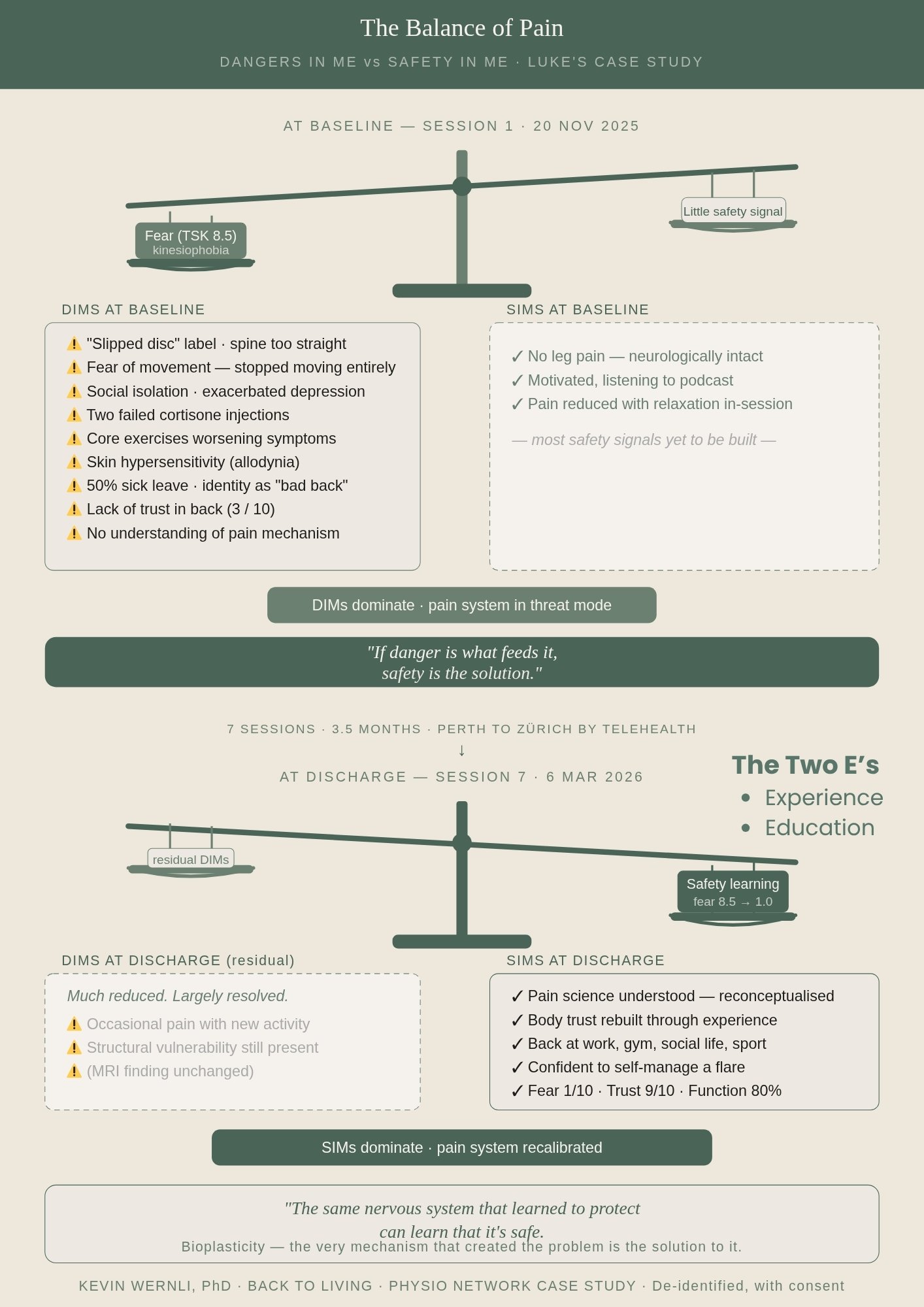
DIMs and SIMs
Dangers In Me vs Safety In Me. Pain volume is set by the balance between threat signals and safety signals — not by tissue findings alone.
03
Predictive processing
The brain predicts pain based on past experience and current context. The same stimulus produces very different pain depending on what it means.
04
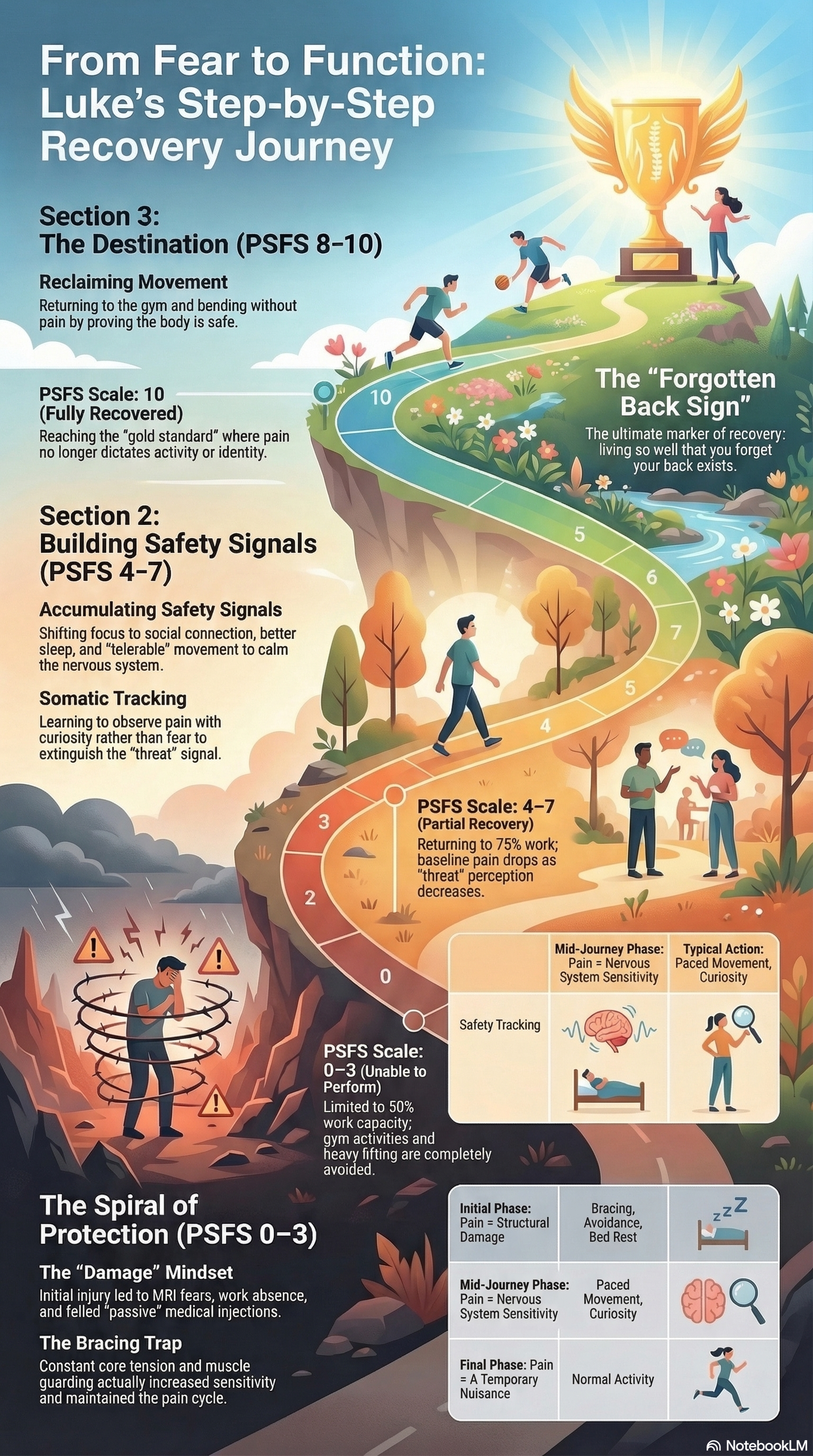
Protection to non-protection
Recovery moves from nonconscious protection → conscious non-protection → nonconscious non-protection. The forgotten back is the endpoint.
05
Safety learning
Graded exposure to feared movements builds a safety evidence bank. The nervous system recalibrates when it repeatedly learns: I did that and nothing bad happened.
06
Nociplastic vs nociceptive
Most chronic back pain is nociplastic — driven by a sensitised threat system, not ongoing tissue damage. The same spine can present differently as biology changes.
Recognising nociplastic pain
Latent pain response
Pain appears hours later — not immediately during the activity
Inconsistent triggers
Same activity sometimes causes pain, sometimes doesn't
Better with movement
Unlike true injury, moving often feels better than staying still
Stress-triggered
Pain clearly tracks emotional state, mood, and life stressors
Scan-symptom discordance
MRI findings and symptoms don't match — like Luke's left herniation with right-sided pain
Failed multiple treatments
Many modalities tried, no lasting structural explanation found

Three things you can take into your clinic tomorrow — the specific language, questions, and frameworks used with Luke.

Tool 01
The In-Session Behavioural Experiment
  • Ask the patient to perform a provocative movement (sit-to-stand works well) in their usual braced, protected way. Note their pain rating.
  • Ask them to relax their belly, breathe out, soften their shoulders, and repeat — without bracing.
  • Note the difference. Let them feel it first. Don't explain yet.
  • Then ask: "What does that tell you about what's driving the pain?"
The clinical principle
"You're not treating the pain — you're generating in-session evidence that violates the patient's danger belief. The mechanism is safety learning, not symptom suppression."
Tool 02
The Reflective Question Framework
  • "What does your body do first when you prepare to move?" — surfaces the bracing, breath-holding, and tension they're not consciously aware of.
  • "What happens to the pain if you relax and breathe before you do it?" — generates the experiment.
  • "What does that tell you about what's driving the pain?" — shifts the locus of learning to the patient, not the clinician.
The clinical principle
"Curiosity and fear are hard to coexist. These questions make the patient the investigator — not a passive recipient of your explanation."
Tool 03
The Threat Ladder for Graded Exposure (with body regulation)
  • Ask the patient to identify and make a list of their most feared, avoided, or provocative movements, postures, and tasks — including things they think are bad, or have been told are bad.
  • Ask the patient to rank them: most threatening at the top, least threatening at the bottom.
  • Start at the bottom — or wherever the patient feels 80–90% confident they will be fine — and design the smallest possible behavioural experiment. Encourage the patient to perform the task with body regulation: calm, mindfulness, relaxation, and breathing. The goal is to increase signals of safety and reduce unhelpful overprotective bracing behaviours. Luke's first experiment was a cup, not a barbell.
  • Build safety evidence upward. Each win reduces the threat value of the task and builds experiential evidence of safety. The nervous system learns it's safe and no longer produces overprotective perceived danger pain — a mechanism called safety learning.
  • Consistency and repetition of even boring, sub-maximal tasks — without feared or unintended consequences — is what drives nervous system and pain system recalibration.
  • Gradually climb the threat ladder and add further challenging contexts: stressful environments, distraction, external loads, unpredictable situations.
  • The outcome of whether the task is less (or more) painful actually doesn't matter that much. The reduction of threat — how fearful or worrying the activity is — matters more, because pain is a downstream consequence of sensation combined with meaning (fear, attention, danger).
Useful equations (simplified):

Sensation + Meaning (attention, fear, worry, threat) = Pain / conscious experience

Sensation + Nothing (no meaning, no significance) = Nothing — the nervous system deprioritises it and it drops into the subconscious.

Example: You can probably feel your foot on the floor right now — because I just mentioned it (meaning/attention). But before I mentioned it, you weren't aware of the sensation at all, even though your sensory receptors were still firing.
Discharge Framework
Three Questions for Discharge
  • "Are you doing everything you want to be doing?"
  • "Are you avoiding anything — even implicitly?"
  • "Are you confident to manage a pain flare if and when it comes?"
Kevin — discharge session
"If yes to all three — you don't need to see me anymore."

A companion podcast episode exploring Luke's recovery story — generated from the session transcripts using NotebookLM. It covers the key turning points, clinical reasoning, and pain science concepts from this case in a conversational format.

Podcast episode
NotebookLM · AI-Generated Podcast
🎙
Luke's Recovery Story — From Slipped Disc to Forgotten Back
A deep dive into this case in conversational audio format — suitable for clinicians and patients alike.

To embed: Upload your audio to Buzzsprout or Spotify → copy the <iframe> embed code → replace this placeholder with the iframe in Squarespace using a Code Block.

Short videos exploring the pain science concepts from this case — for clinicians wanting a visual walkthrough and for patients looking to understand their own pain.

Video resources
Video 01
Pain Science Explainer
Why pain doesn't equal damage — and what the evidence says about nociplastic back pain.

To embed: Upload to YouTube → in Squarespace add a Video Block and paste the URL, or use a Code Block with a YouTube <iframe> embed.

Video 02
The Threat Ladder in Action
A walkthrough of the graded exposure framework used with Luke — from the cup deadlift to full loading.

To embed: Same as above — YouTube or Vimeo Video Block or Code Block with iframe.

Infographic
DIMs and SIMs — Visual Summary
A visual breakdown of the Dangers In Me / Safety In Me framework applied to this case.

To embed: Upload image to Squarespace Assets → add an Image Block → optionally link to a PDF download for a full-resolution version.

Key references

Kent P et al. Cognitive functional therapy vs usual care (RESTORE). Lancet 2023.

Hancock M et al. RESTORE 3-year follow-up. Lancet Rheumatology 2025.

Ashar YK et al. Pain Reprocessing Therapy RCT. JAMA Psychiatry 2022.

Wernli K et al. Protection to non-protection. European Journal of Pain 2022.

Leake HB et al. What patients value learning about pain. PAIN 2021.